Posts

Showing posts with the label synesthesia

Popping the hood on synaesthesia – what’s going on in there?

Image
--> Synaesthesia – a “mixing of the senses” – was a popular scientific topic in the late 19 th century, but fell out of favour during the mid-20 th century, mainly due to the influence of behaviorism, which held that subjective experience was not a suitable subject for serious science. The start of this century has seen resurgence in interest in the topic, partly fuelled by the hope that neuroimaging would provide objective measures of what is happening in the brains of people during synaesthetic experiences. We (Erik O’Hanlon, Fiona Newell and myself) have recently published our own neuroimaging study of synaesthesia, combining structural and functional analyses. Some of what follows is pulled from that paper, which contains references to the many studies cited below. Many of the ideas below are also discussed in a chapter I wrote for the new Oxford Handbook of Synaesthesia : Synaesthesia and cortical connectivity – a neurodevelopmental perspective. The term synae...

The grand schema things

Image
Even a quick glance at the adjacent picture should bring to mind for most people not only the name of this famous person, but a whole host of associated information – what he does (he’s an actor), perhaps some movies he’s been in, who he’s married to, maybe even who he’s no longer married to. Most of this information (depending on one’s level of familiarity with the particulars of the gentleman in question) will have sprung to mind automatically and effortlessly– indeed, it would be very difficult to actively stop it springing to mind, once the person is recognised. (Try thinking of an elephant without thinking of what colour it is). For some people, however, it is anything but effortless – it is impossible. Readers with prosopagnosia , for example, may still be waiting to find out who the hell I’ve been writing about (it’s Brad Pitt). This condition, also known as face blindness, impairs the ability to recognise people by their faces – the visual stimulus of the f...

Probabilistic inheritance and neurodevelopmental phenotypes: location, location, location

Image
Following a stimulating discussion with Jon Brock on the variability of the phenotype in autism and dyslexia, I thought I would explore a little more the influence of randomness on the phenotypic expression of mutations affecting neurodevelopmental processes. I have written about this before , in general terms, but here want to discuss one particular aspect – how probabilistic inheritance of a defect at a cell biological level is played out across the brain and how this influences the emergent phenotype of the individual.   Developmental neurobiologists are well used to the scenario where mutation of a gene leads to an anatomical defect, but only some of the time. Depending on the scale at which the defect is defined that can mean “in only some individuals” – for example, whether the connections between the two hemispheres of the brain form.   In genetically identical people (or animals) carrying a mutation affecting this process these connections some...

Synaesthesia and savantism

Image
“We only use 10% of our brain”. I don’t know where that idea originated but it certainly took off as a popular meme – taxi drivers seem particularly taken with it. It’s rubbish of course – you use more than that just to see. But it captures an idea that we humans have untapped intellectual potential – that in each of us individually, or at least in humans in general lies the potential for genius. Part of what has fed into that idea is the existence of so-called “savants” – people who have some isolated area of special intellectual ability far beyond most other individuals. Common examples of savant abilities include prodigious mental calculations, calendar calculations and remarkable feats of memory. These can arise due to brain injuries, or be apparently congenital. In congenital cases, savant abilities are often encountered against a background of the general intellectual, social or communicative symptoms of autism. (The portrayal by Dustin Hoffman in Rain Man is a good exam...

A synaesthetic mouse?

Image
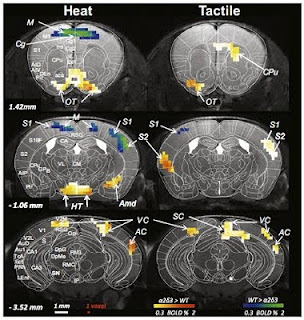
An amazing study just published in Cell starts out with fruit flies insensitive to pain and ends up with what looks very like a synaesthetic mouse. Penninger and colleagues were interested in the mechanisms of pain sensation and have been using the fruit fly as a model to investigate the underlying biological processes. Like any good geneticist faced with profound ignorance of how a process works, they began by screening for mutant flies that are insensitive to pain. Making use of a very powerful genetic resource developed in Vienna (a bank of fly lines expressing RNA interference constructs for every gene in the genome) they screened through all these genes to see which ones were required in neurons for flies to respond to pain. (In particular, pain caused by excessive heat). Why should anyone care how a fly feels pain? Well, like practically everything else you can think of, the basic physiology and molecular biology of pain sensation is very highly conserved from flies to mamm...

Coloured hearing in Williams syndrome

Image
The idea that our genes can affect many of the traits that define us as individuals, including our personality, intelligence, talents and interests is one that some people find hard to accept. That this is the case is very clearly and dramatically demonstrated, however, by a number of genetic conditions, which have characteristic profiles of psychological traits. Genetic effects include influences on perception, sometimes quite profound, and other times remarkably selective. A recent study suggests that differences in perception in two conditions, synaesthesia and Williams syndrome, may share some unexpected similarities. Williams syndrome is a genomic disorder caused by deletion of a specific segment of chromosome 7. Due to the presence of a number of repeated sequences, this region is prone to errors during replication that can result in deletion of the intervening stretch of the chromosome, which contains approximately 28 genes. The disorder is characterised by typical facia...