Posts

The Trouble with Epigenetics, Part 3 – over-fitting the noise

Image
The idea of transgenerational epigenetic inheritance of acquired behaviors is in the news again, this time thanks to a new paper in Nature Neuroscience (who seem to have a liking for this sort of thing). The paper is provocatively titled:   “ Implication of sperm RNAs in transgenerational inheritance of the effects of early trauma in mice ”. The abstract claims that: “ We found that traumatic stress in early life altered mouse microRNA (miRNA) expression, and behavioral and metabolic responses in the progeny. Injection of sperm RNAs from traumatized males into fertilized wild-type oocytes reproduced the behavioral and metabolic alterations in the resulting offspring.” Unfortunately, the paper provides no evidence to back up those extraordinary claims. It is, regrettably, a prime example of over-fitting the noise. That is, finding patterns in a mass of messy data, like faces in clouds, and building hypotheses on them after the fact. If any chan...
Gay genes? Yeah, but no, well kind of… but, so what?

Image
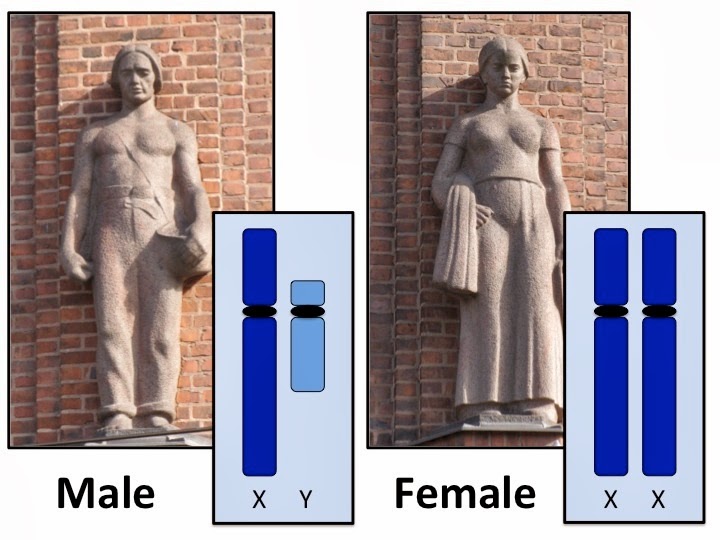
Sexual preference is one of the most strongly genetically determined behavioural traits we know of. A single genetic element is responsible for most of the variation in this trait across the population. Nearly all (>95%) of the people who inherit this element are sexually attracted to females, while about the same proportion of people who do not inherit it are attracted to males. This attraction is innate, refractory to change and affects behaviour in stereotyped ways, shaped and constrained by cultural context. It is the commonest and strongest genetic effect on behaviour that we know of in humans (in all mammals, actually). The genetic element is of course the Y chromosome . The idea that sexual behaviour can be affected by – even largely determined by – our genes is therefore not only not outlandish, it is trivially obvious. Yet claims that differences in sexual orientation may have at least a partly genetic basis seem to provoke howls of scepticism a...

Reductionism! Determinism! Straw-man-ism!

Image
“Reductionism!” is a charge often flung at geneticists, from accusers in the popular press and also, not infrequently, from many fellow scientists. What is it that leads so many people to so fundamentally misunderstand what genetics is about? Whenever someone presents results showing that variation in such and such a trait is partly influenced by genetic variation, or even showing more specifically that mutations in a particular gene can predispose to a particular outcome, someone is sure to shout: “Reductionism! Single genes can’t cause complex traits – it’s patent nonsense to say that they can! Biological organisms are complex systems interacting in complex ways in an ever-changing environment – particular behaviours can’t be simply determined by genes”.   Of course they are right, but they’re also arguing against something no one is claiming. A couple recent examples illustrate this phenomenon. One is the reaction to coverage of a presentatio...

On genetic causality: forwards and backwards

Image
Genetics is getting more complicated. Previously clear and strong links between particular mutations and particular diseases are becoming muddied and weaker with increasing knowledge. Such mutations were usually initially identified in families with a heavy burden of illness, where the mutation segregated clearly with illness. But with our increasing ability to sequence large numbers of people, we are now seeing that many such mutations have a much more variable presentation. Even classically “ Mendelian ” mutations, such as those causing cystic fibrosis and Huntington’s disease , are subject to modifying effects in the genetic background. The same mutation in one person may not cause the same symptoms or disease progression in another. And for more complex “disorders”, such as autism, epilepsy or schizophrenia, these effects are far more endemic. Even in cases where a primary mutation is identifiable, there may often be additional genetic factors th...

The dark arts of statistical genomics

Image
--> “ Whereof one cannot speak, thereof one must be silent ” - Wittgenstein That’s a maxim to live by, or certainly to blog by, but I am about to break it. Most of the time I try to write about things I feel I have some understanding of (rightly or wrongly) or at least an informed opinion on. But I am writing this post from a position of ignorance and confusion. I want to discuss a fairly esoteric and technical statistical method recently applied in human genetics, which has become quite influential. The results from recent studies using this approach have a direct bearing on an important question – the genetic architecture of complex diseases, such as schizophrenia and autism. And that, in turn, dramatically affects how we conceptualise these disorders. But this discussion will also touch on a much wider social issue in science, which is how highly specialised statistical claims are accepted (or not) by biologists or clinicians, the vast majority of whom are unabl...