Posts

Showing posts with the label regeneration

Jump-starting regeneration of injured nerves
Image
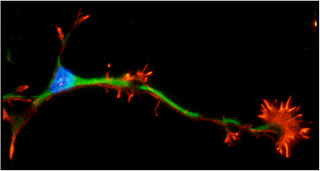
Unlike in many other animals, injured nerve fibres in the mammalian central nervous system do not regenerate – at least not spontaneously. A lot of research has gone in to finding ways to coax them to do so, unfortunately with only modest success. The main problem is that there are many reasons why central nerve fibres don’t regenerate after an injury – tackling them singly is not sufficient. A new study takes a combined approach to hit two distinct molecular pathways in injured nerves and achieves substantial regrowth in an animal model. Many lower vertebrates, like frogs and salamanders, for example, can regrow damaged nerves quite readily. And even in mammals, nerves in the periphery will regenerate and reconnect, given enough time. But nerve fibres in the brain and spinal cord do not regenerate after an injury. Researchers trying to solve this problem focused initially on figuring out what is different about the environment in the central versus the per...
Migrating neurons clear their path

Image
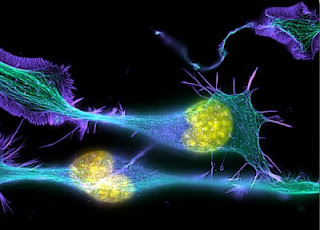
Most neurons in the brain are not born in their final position – they are generated by cell division in one part of the brain and have to migrate, sometimes over long distances, along complicated routes, to finally arrive at their pre-specified destination.   This process entails an incredibly complex and dynamic set of genetic instructions and interactions between different cell types.   A prime example is the migration of interneurons to the cerebral cortex – these inhibitory neurons make up one half of a balancing act that controls all cognitive functions in the cortex, but, unlike the excitatory neurons of the cortex, they are born in a completely different part of the brain (what will become the striatum).   Many researchers have been trying to understand how these neurons find their way specifically to the cortex.   A number of genes have been found which encode guidance cues which can attract or repel the migrating neurons and which mark out their correct pathway.   These cues...