Posts

Showing posts with the label wiring

Why do lemons taste sour? The puzzle of innate qualia.

Image
A really nice recent paper reported the identification of a family of proteins that seem to act as sour taste receptors. They are expressed in our taste buds and allow us to detect the positively charged hydrogen ions produced by acidic substances. This is important because it lets us identify foods that are unripe or spoiled by bacterial growth, like sour milk. The discovery of these sour receptors is a big step forward – it adds to our understanding of how different kinds of chemicals are detected in the sensory neurons of the tongue and processed in the brain. But it leaves one really big question unanswered – why do sour things taste like that ?  Image credit: http://www.funcage.com/blog/babies-tasting-lemons-for-the-first-time/ Why does eating a lemon produce that specific reaction – the scrunched up face, puckered lips, eyes squinting, head drawn back, eyebrows raised in surprise? This is an incredibly universal and apparently innate reactio...

The grand schema things

Image
Even a quick glance at the adjacent picture should bring to mind for most people not only the name of this famous person, but a whole host of associated information – what he does (he’s an actor), perhaps some movies he’s been in, who he’s married to, maybe even who he’s no longer married to. Most of this information (depending on one’s level of familiarity with the particulars of the gentleman in question) will have sprung to mind automatically and effortlessly– indeed, it would be very difficult to actively stop it springing to mind, once the person is recognised. (Try thinking of an elephant without thinking of what colour it is). For some people, however, it is anything but effortless – it is impossible. Readers with prosopagnosia , for example, may still be waiting to find out who the hell I’ve been writing about (it’s Brad Pitt). This condition, also known as face blindness, impairs the ability to recognise people by their faces – the visual stimulus of the f...

Nerves of a feather, wire together

Image
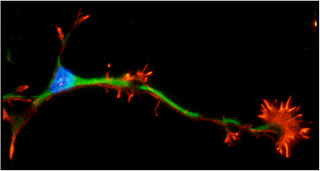
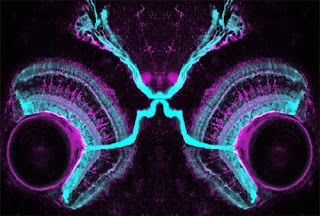
Finding your soulmate, for a neuron, is a daunting task. With so many opportunities for casual hook-ups, how do you know when you find “the one”? In the early 1960’s Roger Sperry proposed his famous “chemoaffinity theory” to explain how neural connectivity arises. This was based on observations of remarkable specificity in the projections of nerves regenerating from the eye of frogs to their targets in the brain. His first version of this theory proposed that each neuron found its target by expression of matching labels on their respective surfaces. He quickly realised, however, that with ~200,000 neurons in the retina, the genome was not large enough to encode separate connectivity molecules for each one. This led him to the insight that a regular array of connections of one field of neurons (like the retina) across a target field (the optic tectum in this case) could be readily achieved by gradients of only one or a few molecules. The molecules in question, Ephrins and Eph rec...

Jump-starting regeneration of injured nerves

Image
Unlike in many other animals, injured nerve fibres in the mammalian central nervous system do not regenerate – at least not spontaneously. A lot of research has gone in to finding ways to coax them to do so, unfortunately with only modest success. The main problem is that there are many reasons why central nerve fibres don’t regenerate after an injury – tackling them singly is not sufficient. A new study takes a combined approach to hit two distinct molecular pathways in injured nerves and achieves substantial regrowth in an animal model. Many lower vertebrates, like frogs and salamanders, for example, can regrow damaged nerves quite readily. And even in mammals, nerves in the periphery will regenerate and reconnect, given enough time. But nerve fibres in the brain and spinal cord do not regenerate after an injury. Researchers trying to solve this problem focused initially on figuring out what is different about the environment in the central versus the per...

Split brains, autism and schizophrenia

Image
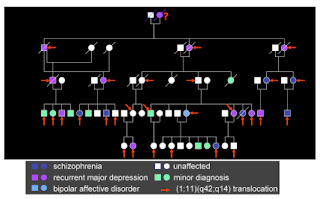
A new study suggests that a gene known to be causally linked to schizophrenia and other psychiatric disorders is involved in the formation of connections between the two hemispheres of the brain. DISC1 is probably the most famous gene in psychiatric genetics, and rightly so. It was discovered in a large Scottish pedigree, where 18 members were affected by psychiatric disease. The diagnoses ranged from schizophrenia and bipolar disorder to depression and a range of “minor” psychiatric conditions. It was found that the affected individuals had all inherited a genetic anomaly – a translocation of genetic material between two chromosomes. This basically involves sections of two chromosomes swapping with each other. In the process, each chromosome is broken, before being spliced back to part of the other chromosome. In this case, the breakpoint on chromosome 1 interrupted a gene, subsequently named Disrupted-in-Schizophrenia-1, or DISC1. That this discovery was made using cl...

On discovering you’re an android

Image
Deckard: She's a replicant, isn't she? Tyrell: I'm impressed. How many questions does it usually take to spot them? Deckard: I don't get it, Tyrell. Tyrell: How many questions? Deckard: Twenty, thirty, cross-referenced. Tyrell: It took more than a hundred for Rachael, didn't it? Deckard: [realizing Rachael believes she's human] She doesn't know. Tyrell: She's beginning to suspect, I think. Deckard: Suspect? How can it not know what it is? A very discomfiting realisation, discovering you are an android. That all those thoughts and ideas and feelings you seem to be having are just electrical impulses zapping through your circuits. That you are merely a collection of physical parts, whirring away. What if some of them break and you begin to malfunction? What if they wear down with use and someday simply fail? The replicants in BladeRunner rail against their planned obsolescence, believing in the existence of their own selves, even with the knowledge ...