Posts

Showing posts with the label neurodevelopment

Are bigger bits of brains better?

Image
We scoff at the folly of phrenology – the simplistic idea that the size and shape of bumps on the skull could tell you something about a person’s character and psychological attributes. It was all the rage in the Victorian era (the early to mid-1800s) in the UK and the US especially, with practitioners armed with calipers claiming to measure all kinds of personal propensities, from Acquisitiveness and Combativeness to Benevolence and Wonder. The skull bumps were just a proxy, of course – the idea was that they reflected the size and shape of the underlying brain regions, which were what was really associated with various traits. It all seems a bit quaint and simplistic now (apart from the entrenched association with racism ), but while we may like to think we have moved on, a lot of modern human neuroscience is founded on the same premises.    - The first premise is that different mental functions or psychological traits can be localised to specific regions of the brain. ...

Is your future income written in your DNA?

Image
A newly published paper makes the claim that variation in people’s income can be partly traced to variations in their genes. Indeed, it identifies over a hundred specific genetic variants that are statistically associated with income in a large sample of people derived from the UK Biobank . To some, this idea is frankly preposterous – a naïve and outrageous over-reach of genetic determinism and reductionism, with strains of social Darwinism. To others, it is completely expected – not trivial, in terms of the work involved, but certainly not at all surprising and not so earth-shattering in terms of social implications. The devil is in the details, of course, of the methodology and the results, and, importantly, the way they are presented and interpreted. The idea that something like a person’s income could be partly heritable – that is, that variation in income across the population could be partly attributable to genetic differences between people – is in fact, not new at ...

The Trouble with Epigenetics (Part 1)

Image
“You keep using that word. I do not think it means what you think it means”. The insightful Inigo Montoya. Epigenetics is a word that seems to have caught the public imagination. This is especially true among those, both in science and without, who decry what they see as genetic determinism or at least an overly “genocentric” point of view. Our genes are not our fate, because epigenetics! Such-and-such disorder is not really genetic, because epigenetics! Acquired characteristics can be inherited, because epigenetics! The trouble with epigenetics is that the word means very different things in different contexts. Each of them may be quite valid, but when these meanings are conflated or when the intended meaning is not specified, the word becomes dangerously ambiguous. This is especially evident in the fields of behavioural and psychiatric research where the term is much abused, often, it seems to me, to give an air of mechanistic truthiness to ideas that a...

From miswired brain to psychopathology – modelling neurodevelopmental disorders in mice

Image
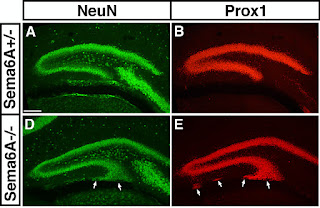
It takes a lot of genes to wire the human brain. Billions of cells, of a myriad different types have to be specified, directed to migrate to the right position, organised in clusters or layers, and finally connected to their appropriate targets. When the genes that specify these neurodevelopmental processes are mutated, the result can be severe impairment in function, which can manifest as neurological or psychiatric disease. How those kinds of neurodevelopmental defects actually lead to the emergence of particular pathological states – like psychosis or seizures or social withdrawal – is a mystery, however. Many researchers are trying to tackle this problem using mouse models – animals carrying mutations known to cause autism or schizophrenia in humans, for example. A recent study from my own lab ( open access in PLoS One ) adds to this effort by examining the consequences of mutation of an important neurodevelopmental gene and providing evidence that the mice...