Posts

Robustness and fragility in neural development
Image
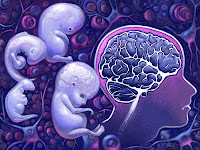
So many things can go wrong in the development of the human brain it is amazing that it ever goes right.   The fact that it usually does – that the majority of people do not suffer from a neurodevelopmental disorder – is due to the property engineers call robustness .   This property has important implications for understanding the genetic architecture of neurodevelopmental disorders – what kinds of insults will the system be able to tolerate and what kind will it be vulnerable to? The development of the brain involves many thousands of different gene products acting in hundreds of distinct molecular and cellular processes, all tightly coordinated in space and time – from patterning and proliferation to cell migration, axon guidance, synapse formation and many others.   Large numbers of proteins are involved in the biochemical pathways and networks underlying each cell biological process.   Each of these systems has evolved not just to do a p...
De novo mutations in autism

Image
A trio of papers in this week’s Nature identifies mutations causing autism in four new genes, demonstrate the importance of de novo mutations in the etiology of this disorder and suggest that there may be 1,000 or more genes in which high-risk, autism-causing mutations can occur. These studies provide an explanation for what seems like a paradox: on the one hand, twin studies show that autism is very strongly genetic (identical twins are much more likely to share a diagnosis than fraternal twins) – on the other, many cases are sporadic, with no one else in the family affected. How can the condition be “genetic” but not always run in the family? The explanation is that many cases are caused by new mutations – ones that arise in the germline of the parents. (This is similar to conditions like Down syndrome). The studies reported in Nature are trying to find those mutations and see which genes are affected. They are only possible because of the tremendous advances in our ability to ...

Nerves of a feather, wire together

Image
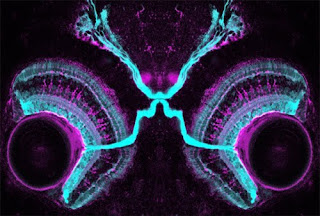
Finding your soulmate, for a neuron, is a daunting task. With so many opportunities for casual hook-ups, how do you know when you find “the one”? In the early 1960’s Roger Sperry proposed his famous “chemoaffinity theory” to explain how neural connectivity arises. This was based on observations of remarkable specificity in the projections of nerves regenerating from the eye of frogs to their targets in the brain. His first version of this theory proposed that each neuron found its target by expression of matching labels on their respective surfaces. He quickly realised, however, that with ~200,000 neurons in the retina, the genome was not large enough to encode separate connectivity molecules for each one. This led him to the insight that a regular array of connections of one field of neurons (like the retina) across a target field (the optic tectum in this case) could be readily achieved by gradients of only one or a few molecules. The molecules in question, Ephrins and Eph rec...

I’ve got your missing heritability right here…

Image
A debate is raging in human genetics these days as to why the massive genome-wide association studies (GWAS) that have been carried out for every trait and disorder imaginable over the last several years have not explained more of the underlying heritability. This is especially true for many of the so-called complex disorders that have been investigated, where results have been far less than hoped for. A good deal of effort has gone into quantifying exactly how much of the genetic variance has been “explained” and how much remains “missing”. The problem with this question is that it limits the search space for the solution. It forces our thinking further and further along a certain path, when what we really need is to draw back and question the assumptions on which the whole approach is founded. Rather than asking what is the right answer to this question, we should be asking: what is the right question? The idea of performing genome-wide association studies for complex disorder...

From miswired brain to psychopathology – modelling neurodevelopmental disorders in mice

Image
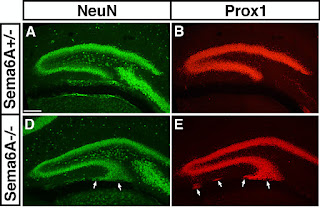
It takes a lot of genes to wire the human brain. Billions of cells, of a myriad different types have to be specified, directed to migrate to the right position, organised in clusters or layers, and finally connected to their appropriate targets. When the genes that specify these neurodevelopmental processes are mutated, the result can be severe impairment in function, which can manifest as neurological or psychiatric disease. How those kinds of neurodevelopmental defects actually lead to the emergence of particular pathological states – like psychosis or seizures or social withdrawal – is a mystery, however. Many researchers are trying to tackle this problem using mouse models – animals carrying mutations known to cause autism or schizophrenia in humans, for example. A recent study from my own lab ( open access in PLoS One ) adds to this effort by examining the consequences of mutation of an important neurodevelopmental gene and providing evidence that the mice...

Jump-starting regeneration of injured nerves

Image
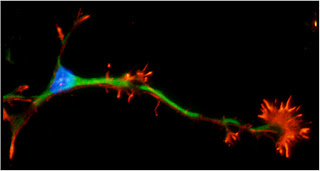
Unlike in many other animals, injured nerve fibres in the mammalian central nervous system do not regenerate – at least not spontaneously. A lot of research has gone in to finding ways to coax them to do so, unfortunately with only modest success. The main problem is that there are many reasons why central nerve fibres don’t regenerate after an injury – tackling them singly is not sufficient. A new study takes a combined approach to hit two distinct molecular pathways in injured nerves and achieves substantial regrowth in an animal model. Many lower vertebrates, like frogs and salamanders, for example, can regrow damaged nerves quite readily. And even in mammals, nerves in the periphery will regenerate and reconnect, given enough time. But nerve fibres in the brain and spinal cord do not regenerate after an injury. Researchers trying to solve this problem focused initially on figuring out what is different about the environment in the central versus the per...

What is a gene "for"?

Image
“Scientists discover gene for autism” (or ovarian cancer, or depression, cocaine addiction, obesity, happiness, height, schizophrenia… and whatever you’re having yourself). These are typical newspaper headlines (all from the last year) and all use the popular shorthand of “a gene for” something. In my view, this phrase is both lazy and deeply misleading and has caused widespread confusion about what genes are and do and about their influences on human traits and disease. The problem with this phrase stems from the ambiguity in what we mean by a “gene” and what we mean by “for”. These can mean different things at different levels and unfortunately these meanings are easily conflated. First, a gene can be defined in several different ways. From a molecular perspective, it is a segment of DNA that codes for a protein, along with the instructions for when and where and in what amounts this protein should be made. (Some genes encode RNA molecules, rather than proteins, but the g...